Sunday, February 8, 2015

A World Of Hockey: SC Bern, Switzerland

Today's Edition of A World Of Hockey features a team from Switzerland that I had the pleasure of seeing! Today we look at the team, SC Bern, from Switzerland's top league, the NLA (National League A). SC Bern is one of 12 teams competing in this league, and are located in the Swiss capitol of Bern. SC Bern was founded in 1930, and ultimately began competitive play in 1931. Their current head coach is former Tampa Bay Lightning head coach, Guy Boucher, and have won the championship for the NLA a total of 13 times (including when the NLA was formerly known as the NDA and also Nationalliga A) starting in 1959.


(I don't own the rights to this image)


SC Bern has some of the highest attendance rates out of any European hockey team (including the KHL as well), averaging almost 16,000 people per home game. I was lucky enough to be a part of that home crowd for a game in January. (More on that below)


This is the jersey I purchased. It's the black home colors. A lot of people seem to have trouble getting past the advertisements on the jersey and the ice. To them I say, without these ads, smaller leagues like Swiss NLA (despite its highest averaging attendance out of all the European leagues) would cease to exist. Once I started considering that, I didn't worry so much about the ads on the ice/jerseys and just enjoyed the hockey.


I didn't take a picture of the sleve, but you'll notice a "2014-2015" on the sleeve by the elbow. I think the reason for this is because the team can sell different designs each year to help further financially support the team. 


GAME ACCOUNT:
This match I attended was the semi-final match in the Swiss Cup Championship, not to be confused with the NLA championship. Some quick background on the Swiss Cup is that it was established in 1957 and featured all Swiss top-tier leagues, which would include not only the NLA, but also the second highest league in Switzerland, the NLB. The tournament ran until 1972, ultimately closing because financial and other reasons that I'm not too sure. SC Bern was able to win a Swiss Cup Championship in 1965.


In May of 2013, the Swiss Ice Hockey Associated announced that they would be restarting the tournament for 2014-2015. So I found myself in Bern on January 7th to experience a game. I didn't know too much about SC Bern other than it was a fairly popular team and that it was pretty big rivals with the team in the "city" I was staying in, Fribourg.

(Fun fact, this was not only due to geographic proximity but also beer sponsorships of the teams. Local Fribourg beer, Cardinale, sponsored Fribourg, while Bern-based Feldschlösschen sponsored SC Bern. Unfortunately both major breweries were moved to different parts of the country, mainly after 
Feldschlösschen bought out Cardinale...oops)
Now from a language perspective, I am fluent in English and very comfortable speaking French. I had been doing that for most of my time in Switzerland. I had also tried to learn as much German as possible before going. The German spoken in Switzerland is extremely different than in Germany. Some Germans view Swiss German as "not real German" (not my words). Either way, it was extremely interesting to see the difference between the Fribourg/Geneva area with mostly French with some English signs and  barely any German and Bern where everything is completely in German.

Either way, getting to the arena, PostFinance Arena, which opened in 1967, was a lot of fun and allowed me to practice some German, mainly asking people if the group I was with was going the right direction. The night's match would be against ZSC Lions, the reigning NLA champions. SC Bern had won the championship for the NLA the year before, so I knew this would be a great game.

For any Buffalo Sabres or New Jersey fans wondering whatever happened to Henrik Tallinder (with all due respect to him though, I really don't think people are...), he's playing defense for ZSC.

If you are interested in going to just about any European league game (hockey or football/soccer), you need to know that there are separate sections in the stands for the home team and for the visiting team. I found tickets for the standing section in the home team section of the arena. There are seats themselves available but for a slightly more expensive price. There were significantly more people in the standing section, as there was more room. Including currency conversion rates (CHF to USD), the ticket itself cost me about $26, which is an incredible offer considering I'm used to the higher prices of North American games.)


(My view during the warm-ups)

Before the teams even stepped onto the ice there was singing, chanting, and yelling from all corners of the arena, by both teams. The most noise were from, and the chants were being lead, by the section of the arena with all the flags and drums. They were being rallied by two men with a megaphone. An unreal atmosphere, nothing like I'd ever experienced before.

I will keep the game recap short, SC Bern scored a goal 9 seconds into the game and the entire arena went bonkers. Throughout the match, the home fans felt the referees missed a lot of major calls and ended up throwing all sorts of cardboard (mainly beer containers) onto the ice. Again, this was nothing like I'd ever seen before. If you threw an item onto the ice (insert Leafs jersey throwing joke here) at any NHL game, you would consequently be thrown out of the arena. (And yet, they usually have trouble finding whoever throws the octopi on the ice at the Joe Louis Arena in Detroit.)

ZSC would ultimately tie it up late in the first period, and the second period was chippy as the crowd got further and further upset at the referee crew. However, late in the third period, SC Bern got a power play, to which the entire arena (even those in the sitting seats) stood up and starting applauding, as if nothing else mattered before that moment. All I could think of was whether or not I had stepped into a Disney sports movie.

And, with 22 seconds to go...

I caught some magic on my phone. (Yes I was being that guy that had his phone out at the game)

SC Bern plays Kloten for the Swiss Cup Final on February 11th in Bern.

SC Bern also participated in the recent Champions Hockey League tournament featuring teams from almost all the European hockey leagues. SC Bern was in Group E with teams HC Trinec from Czech Republic, Stavanger Oilers from Norway, and Tappara from Finland.

SC Bern did not qualify for the playoffs and finished last in their group. Not the finish you want to see (especially because rival Fribourg-Gotteron finished on top of their group D), but it is a good re-introduction to international play for a growing Swiss Program.

Important Links for SC Bern:
-NLA Home page (French or German Option...can be translated through Google)
-SC Bern Website
-SC Bern Facebook Page
-SC Bern Twitter Page
-SC Bern Youtube Page

Thanks for reading! If you have any suggestions, please let me know.Be sure to comment and follow me on Twitter @DTJ_AHockeyBlog for more articles!
Let me know if you'd like to see more videos or pictures from the game. I will gladly post them.

Tuesday, December 30, 2014

Have the New Jersey Devils really had "terrible drafting"? A response

I recently saw an article on Bleacher Report talking about the Devils' terrible drafting since 2001, and how that has decimated the team. Overall I thought the writer (Dave Lozo) brought up some good points, but I wanted to add my own comments on the article.

 First off, before anything else, I can't stand all the talk of Adam Larsson being a "fourth overall bust". He was rushed into the league and it's only been 4 years since his draft. It took Victor Hedman 5-6 years before he fully developed to his potential. Let's face it, defense is one of the toughest positions to develop through the years.

Overall, I think there is a good analysis of the draft years including good graphics of games played vs. number of picks per round numbers. However, I think the jump to "14 years of bad drafting" is just wrong. In those 14 years, the Devils have only had 10 first round picks, and most of them were late in the round. The exception to that being the Larsson pick at 4th overall in 2011.

In my opinion, the greater issue was the inability to retain players that left in free agency or retirement without any sort of compensation. Parise, Gomez, Niedermayer, Clarkson, etc. all left the team (for whatever reason they had) in free agency, and Kovalchuk left in retirement, which resulted in no compensation or return for any of them. These left some pretty gaping holes in the roster that had to be filled by free agency (Jagr, Ryder, Brunner, Clowe) or low-key trades (for guys like Tuomo Ruutu and Steve Sullivan).

I think the writer is overlooking the most obvious reason for the decline of the Devils, though, which is the loss of their franchise forwards, Kovalchuk and Parise. Yes it's a dead horse, and yes it's been beat already through the floor. But I can't stress how much of an impact these two guys had on the future of the franchise. In fact, the team was planning on having the two as their long-term forwards. This resulted in only needing to draft "support" players like two-way forwards and defensemen.

Now am I defending subpar drafting? Nope. But I wouldn't go as far as saying it's "terrible". The goalies that were picked throughout the years? That's due to the fact that the Devils weren't sure if Marty would go anywhere else in free agency after his success like Holik and Gomez did. Even so, Scott Wedgewood (he's struggling as of late) and Keith Kinkaid look quite promising as potential NHL backups.

There are always questionable moves by a GM, like when Lou traded for Cory Schneider with the 9th overall pick in 2013, but it was pretty well known that the Devils would have drafted Max Domi with the pick (David Conte said the guy they would draft was out of the ISS Top 10 at the time, leaving Domi). So would it be better to have Schneider or Domi? While Domi has been looking nothing less than stellar in the OHL and the WJC's in Canada, this is Lou Lamoriello. His success with the Devils came from the philosophy of building from the net out.

The Devils got their goalie to build out from.

Next up: the Defense.

This has been a pretty rough year for Devils fans, no need to sugar coat it. However, one of the few bright spots has been the young defense. In 4 consecutive years, the Devils drafted Eric Gelinas, Jon Merrill, Adam Larsson, and Damon Severson. Only one of those picks was in the first round as well (Larsson). They are all in the NHL lineup (despite an injury to Severson sidelining him until January). Some teams would kill for that kind of consistency. Additionally in the lineup is Seth Helgeson, 4th round pick from 2009 (same year as Gelinas). Also in the pipeline are Steven Santini (a lock for Team USA in the WJC's but sidelined by a wrist injury), Joshua Jacobs, Reese Scarlett, and others.

This isn't even taking into account Mark Fayne, who was drafted in the 5th round of the 2005 draft (left the team in free agency).

The Devils aren't the Red Wings. In fact, only the Red Wings are the Red Wings. Why am I saying this? Because it's generally accepted that the Red Wings have the best scouting department, and that's a huge reason why they've remained competitive throughout the years. However, Detroit has never had the exodus of top franchise players like New Jersey.

So what I'm trying to say about the article is this: Every team has its big draft busts. For the Devils it was Mattias Tedenby, for the Rangers it was Hugh Jessiman, etc. But the main issue that got the Devils where they are is not the inability to draft, but rather the inability to keep and retain key franchise players.

There's still plenty of time to come before we can analyse recent years of Devils drafting, but to gloss over the details of an entire 14 year period as "bad" because of current team struggles is just asinine. What would happen if Chicago lost Toews and Kane, or if Pittsburgh lost Crosby and Malkin, or if Washington lost Ovechkin and Backstrom? You'd bet they would be struggling.

The Devils do have a very shallow forward prospect pool, and I believe this year's draft will be the perfect opportunity to refill it, rather than try to fill holes through free agency. The defense, however, is looking to be extremely promising.

The Article I am talking about.

Thanks for reading. If you want to read more, follow me on Twitter @DTJ_AHockeyBlog.
What do you think? Feel free to comment

Monday, October 13, 2014

Let's Talk About Adam Larsson

Hello all, sorry it's been a while since I've written. Things at school have been pretty busy
.
The New Jersey Devils have started the season off with a 2-0-0 record. While they won games against two teams that combined for a 0-3-2 record so far this year, it is just good for the Devils fans to see a win or two after last season's dreadful start. So the Devils fans are in a good camp right now, despite the big challenge the team will face tomorrow against the Tampa Bay Lightning.

However, there seems to be an emergence of a story that is turning into a thorn into the side of the Devils: What is to be done about Adam Larsson? Before I continue, I understand that while I don't mean to, but writing about this story will "fan the flames" of the story, so to speak. I will try to approach it from as many angles as possible and also include my own opinion. In fact, before I begin, let's just get it out of the way that I'm a big Adam Larsson fan... Like I just got this jersey delivered:
Before we look at anything else, let's talk about what the situation is and how we got there. Adam Larsson was selected 4th overall in the 2011 NHL Entry Draft by New Jersey, after they won the draft lottery that year (Because the Devils were 9th overall in the league at the draft, the highest they could have picked with the lottery win was 4th place). There were questions as to whether he should jump right into the NHL or go back to the Swedish league to develop some more. Remember, at the time, he was only 18 years old.

Before he was even drafted there were whisperings of "Lidstrom" and "Niedermayer" surrounding him, which has resulted in a tremendous amount of pressure on his career development. After a stellar showing at training camp, Larsson made the Devils team that same year, where he tallied 18 points (2G 16A) in 65 games. Unfortunately for Larsson, 65 games is the highest number of games played in a single NHL season for his career.

This is where things get a bit hairy for Adam. Perhaps it was an injury sustained by a massive hit by PK Subban, or a series of benchings for seemingly trivial errors, or maybe being sat in favor of 7th d-man, Peter Harrold on multiple occasions, but something seemed off about Larsson's development. Were people getting impatient with him? Was he being mismanaged? Was he just not panning out as a prospect?

All are possible options. Over the summer, there were a series of roster moves which seemingly benefited Larsson. These moves included using a compliance buyout on defenseman Anton Volchenkov, the UFA defenseman Mark Fayne signing a contract in Edmonton, and the new assistant head coach (after Scott Stevens stepped down), Tommy Albelin, who is supposedly a big supporter of Larsson. On top of all that, Larsson and the Devils agreed to a 1-year, $900K "prove it" contract for the upcoming season.

Insert Jon Merrill, new-coming defenseman that's been on top of the Devils prospect boards since his drafting in the 2nd round of the 2010 NHL Entry draft. Merrill played 52 games in his first NHL season with the Devils last year. Despite two upper-body/head injuries, Merrill really proved himself as a staple on the blue line for years to come. Merrill had a Corsi For% of 53.4%, which was pretty solid for a rookie defenseman.

Insert Eric Gelinas, who made his presence known to the coaching staff with his booming slapshot which would prove to be lethal on the powerplay. Offensively, Gelinas had the highest Points/60 minutes of 5-on-4 (powerplay) time out of any defenseman in the league: about 6.4 points. This was higher than second place, Shea Weber of the Nashville Predators, who had 6.25 points/60. Gelinas had incredible offensive promise and offered something that none of the other defensive prospects could offer: that slapshot. (Keep an eye out for it. He might go up for hardest slapshot in the All Star week in a few years.)

Finally, with Larsson's spot to take on this year's roster, insert Damon Severson. The 20 year old defenseman was drafted in the 2nd round of the 2012 NHL Entry Draft and put up some amazing numbers in juniors. Last regular season, he had 61 points (15G 46A) in 64 games played. For those who don't know, a point per game rate is absolutely incredible for a defenseman. (He had over a ppg in the playoffs that year, scoring 18 points in 14 games.) So there was a lot of hype surrounding the potential offensive side, as well as the overall side to Severson's game. Severson was invited to Devils rookie camp this off-season to play with other prospects including Stefan Matteau and Reid Boucher. Severson impressed the coaching staff enough to get a spot at the team's training camp. Severson had a phenomenal training camp and pre-season, ultimately snatching the spot in the lineup from right under Larsson.

Currently the Devils defensive parings look like this:
Andy Greene - Damon Severson
Eric Gelinas - Jon Merrill
Bryce Salvador - Marek Zidlicky
Extra: Adam Larsson

Was I expecting Severson to come into camp and take Larsson's roster spot? No, absolutely not. Heck, I don't even know if anybody predicted that. I, like most others, thought Severson should spend the first year of his professional debut in Albany to better tune his skills to a bigger game. Nope. He proved me wrong by starting out in the team's season opener at Philadelphia. While he didn't get on the scoreboard, I was quite impressed by his positioning and confidence. Meanwhile, on the other side of the glass, Adam Larsson took the healthy scratch pretty hard. "I don't really want a reason," he said, "All that matters for me is if I'm in or I'm out." Larsson continued on to say that this was the most difficult scratch he's endured.

Damon Severson solidified his presence in the second game of the season where he registered a goal and an assist against the Florida Panthers (his first NHL point and goal), and it looks like Larsson will be a scratch again in the next game against the Tampa Bay Lightning.

So what do you do in this situation? Is it even an issue? I mean the team is winning, and in New Jersey, the team is more important than anything else (the logo on the front of the jersey is more important than the name on the back). From a managerial perspective, you don't want to worry about wasting a 4th overall draft pick, and no coach wants to ruin a young player's development, despite the amount of flack PDB gets from Devils fans.

I was watching the Devils second game against Florida when the announcers (Steve C and Ken D) did a talking segment about the issue that Larsson is facing and Ken Daneyko (one of the 3 numbers retired for the Devils, known as "Mr. Devil", and one of the best defensemen the franchise has seen) gave a really good insight into what happened to him early on in his career. Daneyko was a 1st round draft selection by the then, unnamed New Jersey Devils, in 1982. He started his career in the NHL and had suffered an injury, resulting in him missing a lot of games, and ended up having him be a healthy scratch on many nights after his return from injury.

For the next two years or so (the first 3 years total of his career), Daneyko was swapped between the AHL and the NHL quite a bit of times. However, once a spot opened up for him on the NHL team, full-time he seized his opportunity, and the rest is in the record books (franchise record 1283 career games).

I understand it's been a really frustrating couple of years for Larsson, especially with all the hype behind him before and directly after his NHL draft, but I think it's important for him to realize that his time will come. Remember, he's still only 21 years old. I don't mean to keep pointing to "the next year", but there are two potential openings on the blue line for the Devils next year, as Marek Zidlicky and Bryce Salvador's contracts are ending, and it is questionable as to whether or not they will be re-signed.

For a while, Adam Larsson was compared to the defenseman, Victor Hedman of the Tampa Bay Lightning. Hedman was drafted 2nd overall by Tampa Bay in the 2009 NHL Entry Draft, and never quite lived up to his full potential in the early years of his play. However, 6 years after his drafting, Hedman has been on fire. In his last 16 games, Hedman has scored 17 points (5G 12A), and that's not even including how well he's playing tonight against Montreal. Hedman is 23 years old.

I think any talks of trading Larsson should be stopped immediately. Not only does Larsson have a tremendous number of years of talent ahead of him, but at this point his trade value has decreased a good amount since his entrance into the league. I don't think Larsson will be traded...in addition, I hope he doesn't get traded.

It is important to note that the defensive roster the Devils are currently icing will not stay the same for all 82 games this season. Unfortunately there will most likely be an injury, or there will be a regression of talent of a young defenseman (if Severson doesn't regress from his current form, he will win the Calder trophy). Larsson will get his chance to play, and he will have to capitalize on his chances, much like Daneyko.

We don't know what the season will look like for Larsson, the young defensemen on the team, or the Devils team for that matter. I think in the case of Larsson, patience is required on all sides of the issue, as defensemen take a long time to develop into steady NHL presences. Larsson will have to give reason this season as to why the Devils should extend his contract, and an almost guaranteed (emphasis on almost) will be open for his taking for next season. However, with defensive prospects like Seth Helgeson, Joshua Jacobs, Steve Santini, and Reece Scarlett, the competition will be absolutely fierce.

As I mentioned before, I cannot emphasize enough the importance of patience for both parties. The good news is that even though Larsson's contract is only for 1 year, he is still a RFA after the end of the current contract. I still think Larsson's potential is through the roof as a top-pairing, elite defenseman in today's NHL. By god, he's still only 21 years old. He will get the chance to prove himself this season, and I really hope he does. Above all else, though, the team is doing well.

What do you think about Adam Larsson's situation and future with the Devils?
Thanks for reading?
If you want more, follow me on Twitter @DTJ_AHockeyBlog!

Sunday, September 21, 2014

A Statistical Look at Alexandre Burrows

The 2014-2015 season will mark Alexandre Burrows' 10th season in the league, all with the Vancouver Canucks. The left-handed forward was undrafted and fought his way through the QMJHL and the ECHL to crack the Canucks line-up. His highest scoring season was the 2009-2010 campaign where he scored 67 points (35G 32A) in all 82 games. In the next two season, Burrows would average 50 points a season (48 points, and 52 points, respectively) all while registering a shooting percent all around 15%. In the lockout-shortened 2012-2013 season, Burrows scored 24 points (13G 11A) in 47 games played, with a 9.3% shooting.

So I think the biggest question Canuck (and non-Canuck) fans are asking is, what the heck happened last season? We had seen 4 straight 20+ goal seasons, and a season, if fully played where Burrows might have hit 20 goals, and then the 2013-2014 season, where Burrows scored 15 points (5G 10A) in 49 games. So let's take a look into the numbers of what happened, because they are far more than what the conventional stats say.
 In the very first game of the season, the Canucks were playing the San Jose Sharks when Burrows dove to block a slapshot during a San Jose 5-on-3 advantage. While out for a couple weeks, Burrows was injured when a puck hit him in the face while on the penalty kill in a December game against the Carolina Hurricanes. So the answer is simple, right? We take Burrows off the penalty kill unit, and all will be dandy...Except it's not that simple. While he was on the ice last season, Burrows was a solid staple on the penalty kill. Of all the forwards who averaged over 1:00 of penalty kill (4-on-5) time per game (60 min), Burrows was 2nd on the team in blocked shots for, with 26.1/60, which averages to 0.87 blocks per 2 minutes of penalty kill ice time. To put into perspective, the leader on the team (who falls under the aforementioned parameters) was Christopher Higgins, who averaged 28.1 blocks/60. This averages to .94/2. And while it's important to note that Burrows' on-ice corsi during the penalty kill was worse than his off-ice corsi (-82.30% vs. -67.45%), keep in mind that of the forwards on the Canucks who averaged more than 1:00 of penalty kill ice time per game, Burrows had the second-highest QOC rating, which is a statistical look at the on-ice competition a player faces. I will saw though, that this stat alone is a bit flawed because taking out the average time requirement, Burrows' QOC rating was 5th on the team. I say this because the three players directly above Burrows, David Booth, Zac Dalpe, and Zack Kassian, all had average ice times of less than 0.10 minutes (less than 6 seconds of penalty kill ice time) per game. They averaged 0.05, 0.03, and 0.01 minutes, respectively. If you're curious for more stats, you can follow this link to BehindtheNet, where I got all the information.

Here is a table of some other stats from the site above:
PlayerTeam Sv %BF/60 OnG/60 OnGA/60 Off
Alex Burrows90126.14.686.05
Ryan Kesler81124.96.684.09
Christopher Higgins83028.15.615.07
Brad Richardson91817.53.335.25

Moving on!


This is a player usage chart I got fromSomeKindOfNinja. In case you haven't read any of my articles, I love player usage charts simply because of the visual aspect of a tremendous number of statistics they show. Let's break this one down! This is a chart depicting 5-on-5 (even strength) stats including offensive zone start%, QOC and Corsi R%. Each player is represented by a circle. Do you see Burrows' circle? It's all the way on the right, right near his line-mates for most of last season, Henrik and Daniel Sedin. The further right a player's circle is means the higher percentage of offensive zone starts. The higher up on the y-axis for a circle is indicative of higher Quality of Competition a player faced. If a circle is blue, then the player has a positive corsi rating, while a red circle means the player has a negative corsi rating. The smaller a circle is is indicative of a Corsi Relative% closer to 0. So it's better to have a large blue circle than a large red circle. There is a positive correlation between higher offensive zone start percentage and corsi percent, and I will elaborate on that a bit later. Burrows had the 6th highest Quality of Competition rating (0.48), while having the highest offensive zone start percentage (61.3%).
 Burrows' standard Corsi% average for his entire career (ignoring zone-start) is 54.6%. So this past season's number, 56%, while lower than the two previous seasons (58.4% and 58% respectively), was higher than his career average. Since a high number of offensive zone starts can inflate a player's overall Corsi, there is a way to compare all player corsis, despite the number of offensive zone starts. This is called Zone-start adjusted Corsi. Burrows' ZSACorsi from last season was 53.966%.
I am having trouble finding any seasonal summary of Burrows' zone exit/entry as well as passing distribution stats, which is too bad (If anybody has some, would you mind sharing?). While zone exit stats focus more on defensemen, zone entry stats are more indicative for forwards.
One more stat I'd like to look at is PDO, which is essentially a measurement of on-ice "luck". It combines on-ice save percentage and on-ice shooting percent. A score of 1000 is considered normal, while anything above 1000 is considered lucky, and anything below it, unlucky. Burrows' career PDO is roughly 1016, which is above-average in the quantified luck department. His PDO from the past season was 970, his career lowest, and 10th lowest in the league last season.
So the reason for Burrows' struggles last season was a combination of a series of injuries, strong defensive role and playing tough competition (Burrows was tied for 3rd on the team in QOC TOI% with 29.2%), and incredibly, almost comically, bad luck when shooting the puck towards the net (second lowest season shooting percentage in his career). Do I think Alex Burrows will bounce back? Of course, the numbers are all pointing to it! Now I don't think his offensive numbers will bounce back to right where they were, considering the fact that he might still be a bit rusty, and that he will most likely play on the second line of Vancouver, with Nick Bonino as center. Playing on the second line will help Burrows' bounce-back because his competition won't be as tough on the ice.

Pre-season is just about here, and every Canuck fan is looking forward to a bounce-back season from Alexandre Burrows.

Like what you read? Follow me on Twitter @DTJ_AHockeyBlog for more articles!

Wednesday, September 17, 2014

A World of Hockey: Perth Thunder, Australia

Today's edition of "A World of Hockey" finds us in the land down under, Australia...Western Australia to be precise. I find it an interesting time for Australian hockey considering at this most recent NHL Entry Draft, we saw the Washington Capitals select forward Nathan Walker 89th overall, becoming the first Australian-born player to be drafted into the NHL.

 The Perth Thunder are one of 8 total teams competing in Australia's top, semi-professional, league, the Australia Ice Hockey League (from now on referred to as the AIHL). The Thunder was founded in 2010, and later that year were able to gain a provisional license to begin play in the 2011 season, so it's a rather young team! They play their home games in Perth Ice Arena. Their General Manager, Stan Scott, also served as the team's head coach from 2012-2013, stepped down for a few months (April-May) in 2014, and is resuming his role as a head coach later that year (2014). 


Their colors are red, blue, and white, and feature red based home jerseys, and white based away jerseys.
   
                             (Home)                                                  (Away)
                                            (Jersey images found through Google)
The Perth Thunder are named after the city they play in, Perth...yup. But on a more serious note, it looks like the name, Thunder, is named after the 2010 Western Australian storms, which swept through cities in south-western Australia. The storms ended up causing over $1 Billion in repairs, the most expensive natural disaster in Western Australian history. I'm not sure how true this may be, but considering that the storms occurred in March of 2010 and the team was founded in later that same year, I'm pretty sure it's no coincidence.
Over the 3 year history of the franchise, they have only made the playoffs once, in 2013. (The AIHL season plays from mid-April through late August/early September of the same calendar year) Their record for last season, the 2014 campaign, was 9-15 with 2 SO wins and 2 SO losses. This was a bit of a drop-off from making it to the semi-finals of the playoffs the season before (their record then was 17-9 with 1 SO win and 1 SO loss).
The team's captain is Australian-born forward, Samuel Wilson. The alternate captains are Canadian-born forward, Daniel Ruck, and New Zealand-born forward, Andrew Cox. The Thunder's leading goal scorer from last season, Stuart Stefan, scored 44 points (14G 30A) in 28 games. The Thunder's second leading scorer was Justin Fox, who had 40 points (20G 20A) in just 21 games last season. You can find more information about the team stats over at the EliteProspects page, and at The AIHL player stats page. Looking at the roster, there looks to be 23 players. Of those 23, only 8 were born in Australia. In total there are 16 players on the team who are Australian citizens. The countries from where the other 7 players are from are New Zealand, USA, Canada, Finland, and UK.


While the team may not do live video streams of their games, they have very active social media accounts. The above video is from the Perth Thunder's Official Youtube Page, to which I will link later below.

Hockey is growing in Australia, and it's nice to take a look at one of the teams in the growing league! With the addition of the Perth Thunder, the AIHL split the teams into two conferences in order to "manage costs and length of the season". I mean, after all, it really can get lonely all the way over on the left:

(From EliteProspects)

While the population of Australia is very skewed towards the Eastern coast, is there a possibility of adding another team along the West coast, near Perth? Just some food for thought.

Important Links:
-AIHL Website
-Perth Thunder Web Site
-Perth Thunder Facebook Page
-Perth Thunder Twitter Account
-Perth Thunder Youtube Account
-More information from EuroHockey

Any comments or suggestions for what teams to write about next? Let me know! Don't forget to follow my Twitter account @DTJ_AHockeyBlog for more articles! Thanks for reading.

Tuesday, September 16, 2014

A Statistical Look at Eric Gelinas

Rookie defenseman, Eric Gelinas, really turned some heads in his first season with the New Jersey Devils. I feel this would be an appropriate time to look at his stats, considering that he just signed a 1 year extension with the team, worth $900,000...also known as a bridge contract, or a "prove-it" in my own view. As far as stats go, for defensemen it isn't as cut and dry to determine value, as there are so many different types of defensemen in the league. If we're going to use the terms EA uses for the NHL-franchise video games, there can be offensive defenseman (think Mike Greene from the Caps comes to mind), defensive defenseman (Kimmo Timonen), two-way (Ryan McDonagh), and enforcer (Zdeno Chara). Since there are so many possible uses of defensemen, there are a few overall ways to quantify performances of defensemen, such as basic and possession stats, zone start analyses, zone exit and entry stats, and player usage charts come to mind, immediately. In addition to the quantified evaluation, there is a certain qualitative analysis that goes into valuing a player (every player, not just defensemen). Do they fit into the team system? Are they able to hold their own? These are all important factors that must be taken into consideration when looking at a player.
So let's begin!

I think the first thing that really caught the attention of not only the coaching staff, but the fans, to Eric Gelinas happened a year ago today. In the beginning of the third period of a pre-season game against the Rangers, a powerplay was coming to a close when Gelinas got the puck along the blue line. With a quick movement of his hands, the puck was in the back of the net.


Gelinas played in 60 games in the NHL this past season and accumulated 29 points (7G 22A) in that time. His 6'4", 205 pound frame helped solidify his physical presence on the blue line. Gelinas became a real fan-favorite when his slapshot found the back of the net, once again against the Rangers. This time though, it was in overtime in MSG.


Okay, so a big, strong rookie defenseman emerges with a wicked slapshot. What happened? Well, there's a difference between using a young player to his advantages and helping him develop as an overall player. Gelinas found himself more and more limited to the powerplay, where he was on the point, rightfully so. But that was about it, really, for the NHL level. Eventually, Gelinas was sent down to Albany, the AHL affiliate of the Devils, to help further his development before stepping onto the "big ice" again. Personally, I think management sent him down after the disastrous outdoor game for the Devils, against the Rangers at Yankee Stadium, in January. Gelinas was caught a little flat-footed in his own end which resulted in lots of scoring chances and odd-man rushes for the Rangers. Justin Bourne, a writer for TheScore, does a fantastic breakdown of some of the things that went wrong in this article.
It's interesting to think about the difference between the progression of the NHL year between Eric Gelinas and fellow rookie defenseman, Jon Merrill. They both started on what seemed like opposite ends of the spectrum: Gelinas started out really hot and eventually cooled down, while Merrill was very quiet in his game, and eventually really began to step up as a defensive staple on the team. As for Gelinas's future role on the team? There's no doubt that slapshot is his key to the NHL, but I expect fellow offensive-defenseman, Marek Zidlicky, will mentor Gelinas on responsibility in pinching along the boards and providing offense without being a liability in one's own end. Unfortunately I don't see the possibility of the two being on the team for a very long time, since, right now, they are extremely similar in playing style.
But now that the qualitative look at Gelinas is over, let's look at some more numbers.
This picture above is called a player usage chart I copied from SomeKindOfNinja, a useful site for charts. Do you see Gelinas's circle? It's the small one on the very right. I have used player usage charts before in previous articles, so this is not something new, however this is a little different of a graph. Essentially the higher a circle is up on the y-axis, the tougher opponents they faced. The further right on the x-axis means the more times they are deployed for offensive zone face-offs. This is indicative of an offensive-defenseman, and can oftentimes boost one's corsi rating. Gelinas's circle is red because his Corsi relative% is negative, and if a circle is blue, like Adam Larsson's, it means that the Corsi relative% is positive. The size of the circle is indicative of the "size" in difference of Corsi relative%. What that means is that the smaller a circle is, the closer a Corsi relative% is to 0. Gelinas's Corsi relative% is -0.7, while Marek Zidlicky's is -1.6%, so Gelinas has a smaller circle because his Corsi relative% is closer to 0. Remember, this is 5-on-5 (even strength) ice time stats. 


The graph above is a look at how Gelinas compares to the other defencemen on the Devils in the categories of Corsi For% (blue), and Corsi Caused% (red). Gelinas flaunted the highest Corsi Caused% of any Devils defenseman last season, and but had the second-lowest Corsi For%.

 Gelinas logged 808:39 minutes of even-strength ice time last season. In that time, he registered 11 points (2G 9A) and had a 53.2% CorsiFor%. Taking into account his large amount of offensive zone starts, Gelinas's Zone-Start-Adjusted Corsi is 50.77%. His even strength stats included 0.148 goals/60min, 0.668 assists/60min, for a total 0.816 points/60min of ice time. While those numbers may not jump off the charts, remember that he is still a defenseman. How do these numbers compare to his powerplay stats. Gelinas played 141:02 minutes of ice time on the powerplay last season, registering 15 points (3G 12A) in that time. These numbers lead to a 1.276 goals/60 min, 5.105 assists/60min for a total 6.381 points/60min of powerplay time. How do these numbers compare to another offensively-focused defenseman? Below is a table differentiating Gelinas's numbers from Senators' defenseman, Erik Karlsson.

(Karlsson's numbers are just derived from this last season)

Gelinas Karlsson
ES G/60  0.148 0.518
ES A/60 0.668 0.852
ES P/60 0.816 1.37
PP G/60 1.276 0.75
PP A/60 5.105 4.126
PP P/60 6.381 4.877

This is not to say that Gelinas is a better or worse offensive-defenceman than Erik Karlsson. These numbers are just for reference. (All of these numbers were gathered from stats.hockeyanalysis.com.)

There is a statistic in hockey known as PDO, which is a measure of luckiness on the ice. It combines the shooting% of a player or a team as well as the team's save%. A PDO of 1000 is considered normal, and a PDO higher than 1000 is considered "lucky, and lower is considered "unlucky". Gelinas's PDO, according to ProgressiveHockey was 1008. This measurement is meant to show that Gelinas did not just get lucky on his goals and on the ice over the course of the season. Just for reference, the lower PDO last season was Alex Edler of the Vancouver Canucks, with a 954 PDO, and the highest PDO belonged to Dustin Penner and Gustav Nyquist, with scores of 1056. Interesting to note that Steve Bernier of the the Devils is second-lowest on that list, with a PDO of 959.

Two key stats for a defenseman, in my opinion, are passing % and zone exit numbers.


Player GP %DZ P %NZ P %OZ P O/DSt%
Marek Zidlicky 81 61.9 12.6 25.5 59
Adam Larsson 26 80.8 8.5 10.7 58
Andy Greene 82 68.9 13.4 17.7 47.2
Mark Fayne 72 70.8 13.5 15.8 47.2
Peter Harrold 33 68.2 11.3 20.5 50.8
Eric Gelinas 60 71.7 12.8 15.6 63.3
Bryce Salvador 40 77 8.7 14.4 51.3
Anton Volchenkov 56 73.4 12.1 14.5 49.7
Jon Merrill 52 69.2 13.7 17.1 55.5
Totals/Averages 502 69.4 12.4 18.2 53.6

Above are passing numbers for all Devils defensemen last season, taken from an article from In Lou We Trust. The measurements in the %DZP, %NZP, and %OZP are the percentage of passes made in each zone. For example, Eric Gelinas's %DZP was 71.7. That means that out of all the passes Gelinas made over the 60 games he played last season, 71.7% of them were in the defensive zone. 12.8% of his passes came in the neutral zone, and 15.6% of his passes came in the offensive zone. The very right column is a measurement of pass completion %. This means that of all the passes that Gelinas attempted last season, he completed 63.3% of them, which was the highest on the team.


Player GP Successes Attempts %Success Rate Poss. Exits %Poss. Exits Success/GP Attempts/GP D-Zone T/GP
Marek Zidlicky 81 599 733 81.7 335 45.7 7.4 9 1.51
Adam Larsson 26 187 231 81 104 45 7.2 8.9 1.35
Andy Greene 82 684 853 80.2 370 43.4 8.3 10.4 1.52
Mark Fayne 72 387 488 79.3 212 43.4 5.4 6.8 1.18
Peter Harrold 33 230 308 74.7 127 41.2 7 9.3 1.73
Eric Gelinas 60 321 432 74.3 187 43.3 5.4 7.2 1.55
Bryce Salvador 40 204 294 69.4 108 36.7 5.1 7.4 1.78
Anton Volchenkov 56 304 372 81.7 132 35.5 5.4 6.6 0.8
Jon Merrill 52 346 430 80.5 195 45.3 6.7 8.3 1.23
Totals/Average 502 3262 4141 78.8 1770 42.7 6.5 8.2 1.39

This chart is much wider, so mobile users aren't going to be too happy with it, but I really think it's just as important. This is a measurement of zone exit stats (from the same ILWT article). Like the passing table above, I included the entire defense for comparison. So let's break it down. Eric Gelinas had the puck in his own zone and attempted to exit the zone (get it?) into the neutral zone 432 times last season. Of those 432 times, he succeeded 321 times, meaning he had a success rate of 74.3%, which was actually below the team average of 78.8%. A defensive zone exit can either be done one of two ways: passing the puck or carrying it yourself. Carrying it yourself is referred to in the chart above as "Possession exits". Gelinas had 187 possession exits, meaning that 36.7% of his zone exits were possession. The next column is an average number of attempts and successes per game. Gelinas is averaging 5.4 successes of 7.2 attempts per game, which are both lower than the team average. This isn't necessarily a bad thing though.When a player is unable to exit the defensive zone, it is because of a turnover. The last column measures the average number of defensive turnovers per game. Gelinas 1.55 defensive turnovers per game. This isn't very good, but it's about the same as Andy Greene and Marek Zidlicky.
Gelinas is going to have to earn his spot on the team in the upcoming training camp, but that is a distinctive possibility. Devils fans know that they have a gem with this kid and that he is going to be a big player in a few years. He just needs to work more on his defensive game if he wants to thrive in the New Jersey system.

Like what you read? Follow me on Twitter @DTJ_AHockeyBlog for more articles!

Monday, September 15, 2014

A World of Hockey: Anyang Halla, South Korea


        The semester is proving to be much more writing-intensive than I had first imagined, but I want to write about something a little bit different. There’s an entire world of hockey out there. Did you know there are 4 ice hockey leagues in Mexico? There are 2 leagues in Thailand, 3 leagues in Turkey, 7 leagues in Poland, an international team in Kuwait, etc. The list goes on! In Canada, alone, there are over 200 registered ice hockey leagues, with almost 1300 teams! As important as the National Hockey League is to me, there is so much more hockey out in the world that I don’t think gets any attention. This could be because of a much lower skill level in the leagues, or because of the focus on another sport, mainly soccer/futbal. So I’m going to write a post, every once in a while, about a foreign league team, and title the section: A World of Hockey. So without further ado, here is Anyang Halla from South Korea.


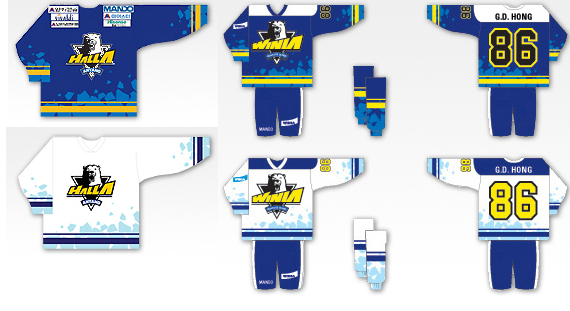
Anyang Halla was founded in December of 1994 in Anyang, South Korea. Their home arena is the Anyang Sports Complex in Anyang, and their colors are blue, gold, and white. Their home jerseys have a blue base color, while the away jerseys have a white base color. 


The team captain is 26-year-old, Korean-born defenceman, Kim Woo-young. The alternate captains are Korean-born defenceman, Kim Bum-jin and Canadian-born forward, Brock Radunske. As of now the head coaching position is vacant. This is due to the last head coach, Shim Eui-sik being fired in May of 2014 for “locker room related issues”. There are 23 players currently on the roster for Anyang Halla. Of those, 4 were born in another country, and 1 of those foreign-born players is now a naturalized Korean citizen. The ALIH is not well known for bringing in foreign talent, and I can understand why. If they are trying to improve the hockey programs in their own country, why would they want to bring in other people to take their jobs (as players on the ice)? That doesn’t mean they’re not interested, though, because bringing in good foreign talent will bring attention to the league, and, in turn, can help spread the game more around. While there have only been a handful of NHL players imported to play for Anyang Halla and the ALIH, the majority of imported players come from the Czech Republic and other lower-tier leagues in the world.

                 The leading scorer from last season was Brock Radunske, who scored 65 points (29G 36A) in 40 games last season. Mike Testwuide cam in second in scoring with 54 points (27G 27A) in 42 games. The entire stats list from last season can be seen here. From 2003 to present (under the name Anyang Halla), the team has amassed a total record of 209-115-20-9, with 13 OT wins, 20 OT losses, 9 ties, 12 SO wins, and 13 SO losses.

As the 2014-2015 season has started underway, Anyang Halla finds itself with a record of 2-3-1, good enough for 5th place in the league so far.

                The team gets its name from the owning body of it, the Halla Group, a South Korean business conglomerate. The company sponsors several hockey teams, including Anyang Halla and Kiekko-Vantaa, in a smaller Finnish league. Originally founded to help promote hockey in Korea, the team was originally named “Mando Winia”, named after a subsidiary company of the Halla Group, Mando. The team was known as “Mando Winia” from1994-1997. In 1998, the name was changed to “Halla Winia”, and stayed that way until 2004, where the name was changed to “Anyang Halla Winia”. Ultimately, in 2005, the name was changed to the present “Anyang Halla”.
                Before joining the Asia League Ice Hockey, from here on referred to as ALIH, Anyang Halla was a member of the Korea Ice Hockey League. In that league, Anyang Halla was one of 4 teams in the league, and were able to win the championship 5 times starting in 1998. In 2003, Anyang Halla was one of the founding member teams of the new league, the Asia League Ice Hockey. This new league arose because of the large amount of teams that folded in the Korea Ice Hockey League as well as the Japan Ice Hockey League. The leagues, essentially, decided to form together, along with a team from China in what they call “The Three Kingdoms on Ice”. As a member of the ALIH, Anyang Halla has won the championship twice, in 2010 and 2011. Anyang Halla is one of 3 total Korean teams in the ALIH. The other two are High1 and Daemyung Sangmu.
 Anyang Halla has one retired number, and that's #91 for Shim Eui-sik (the same head coach who was recently fired in May). In his entire playing career with Anyang Halla, Shim Eui-sik was the MVP of the Korean League 5 times, and held the record for most goals and points.


Interview from 2013 with Brock Radunske:


Anyang Halla's Official Team Song:


Highlights from a game last season:


More ALIH game highlights from last season can be found on this Youtube playlist.


And this one, specifically for Anyang Halla:


As of now, I'm having trouble finding ways to actively watch live streams of the games, so I can only go based off of highlight videos and standings updates.

Important Links:
-ALIH Web Site
-Anyang Halla team web site (if you have Google Chrome, it can automatically translate the page for you)
-Anyang Halla Facebook Page
-Anyang Halla Twitter Account
-More information from Eurohockey

Any comments or suggestions for what teams to write about next? Let me know! Don't forget to follow my Twitter account @DTJ_AHockeyBlog for more articles! Thanks for reading.